JARM#
JWT Secured Authorization Response Mode (JARM) is an OpenID/OAuth extension that returns the authorization response as a JWT (response parameter) instead of plain URL parameters like code or access_token. See the specification for protocol details: OAuth 2.0 JWT Secured Authorization Response Mode (JARM).
In Janssen Server, JARM is supported at the authorization endpoint through these response modes:
query.jwtfragment.jwtform_post.jwtjwt(shortcut mode)
For response_mode=jwt, Janssen follows the JARM default mapping:
response_type=code->query.jwt- response types that include
tokenand/orid_token->fragment.jwt
This means jwt acts as a shorthand, and Janssen automatically chooses where the response=<JWT> parameter is delivered based on response type:
- Code flow only: returned via query component (
query.jwt) - Implicit or hybrid-style flows (any response type containing
tokenorid_token): returned via fragment component (fragment.jwt)
Configure JARM in Janssen Server#
JARM configuration has two layers:
- Authorization Server capabilities (global)
- Client metadata (per RP/client)
1) Authorization Server capabilities#
These global properties define supported JARM response modes and allowed signing/encryption algorithms:
- responseModesSupported
- authorizationSigningAlgValuesSupported
- authorizationEncryptionAlgValuesSupported
- authorizationEncryptionEncValuesSupported
You can configure them using the Janssen TUI by navigating to Auth Server -> Properties, or through Config API/JSON configuration management.
2) Client metadata (per client)#
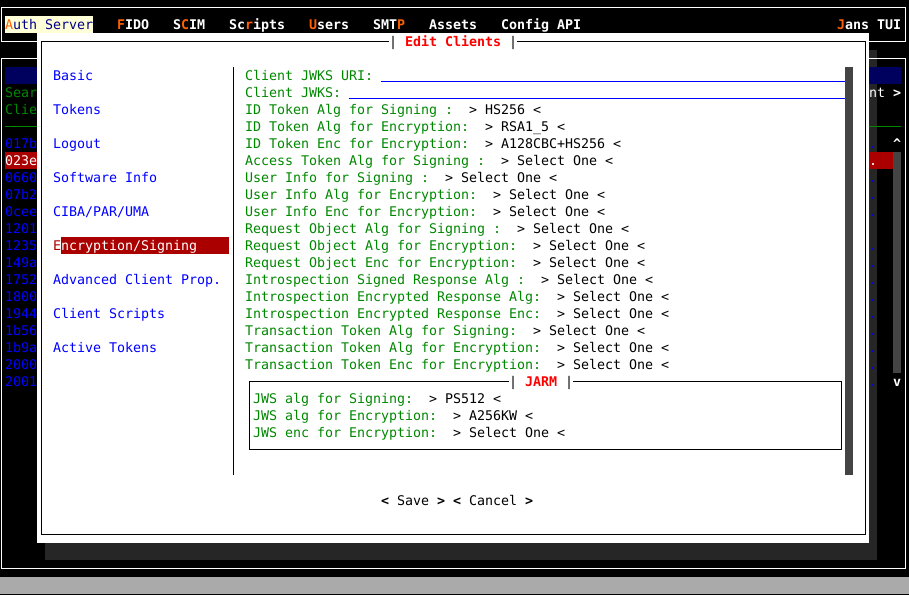
To make a client use JARM, configure client metadata through Dynamic Client Registration or client management APIs/UI:
authorization_signed_response_alg(JWS algorithm;noneis not accepted)authorization_encrypted_response_alg(optional, for JWE)authorization_encrypted_response_enc(optional, for JWE content encryption)
At runtime:
- If only
authorization_signed_response_algis set, Janssen returns a signed JARM JWT - If encryption fields are set, Janssen returns an encrypted JWT (or nested signed+encrypted JWT when signing is also configured)
You can configure them using the Janssen TUI.
Important endpoints and discovery metadata#
Authorization endpoint#
JARM is used on the standard authorization endpoint:
https://<your-domain>/jans-auth/restv1/authorize
Include response_mode in the authorization request, for example:
response_mode=query.jwt
or:
response_mode=jwt
OpenID configuration endpoint#
Use discovery to confirm runtime support:
https://<your-domain>/jans-auth/.well-known/openid-configuration
Important discovery claims for JARM:
response_modes_supportedauthorization_signing_alg_values_supportedauthorization_encryption_alg_values_supportedauthorization_encryption_enc_values_supported
JWKS endpoint#
Clients validate JWS signatures from the authorization response JWT with AS keys from:
https://<your-domain>/jans-auth/restv1/jwks
Request and response behavior#
Authorization request#
Typical parameters are the same as standard authorization requests, with added JARM response mode selection:
client_idredirect_uriresponse_typescopestatenonce(required for relevant OIDC/implicit-hybrid flows)response_mode=query.jwt|fragment.jwt|form_post.jwt|jwt
Authorization response#
Instead of plain fields in query/fragment/form body, Janssen returns:
response=<JWT>
The JWT includes standard authorization response data such as success or error fields (for example code, state, error) as JWT claims.
FAPI note#
When fapiCompatibility is enabled, Janssen applies stricter checks. In this mode:
response_type=codemust useresponse_mode=jwtresponse_mode=queryis rejected
This aligns with the stricter JARM/FAPI behavior enforced by authorization request validation.
Why use JARM and use cases#
JARM helps clients validate authorization responses cryptographically and reduce risks from front-channel tampering.
Common benefits and typical Janssen JARM use cases:
- Response integrity via JWS signatures
- Optional response confidentiality via JWE encryption
- Better fit for high-assurance profiles (including FAPI-style deployments)
- Consistent JWT-based validation model at the client side
JARM is specifically useful in:
- Financial/regulated ecosystems where signed (and often encrypted) front-channel responses are required
- Hybrid and implicit-style response handling where front-channel payload protection is important
- Multi-party integrations where response authenticity must be independently verifiable by clients
- Security hardening programs that standardize on JWT validation patterns across OAuth/OIDC responses